Seeing Through The Wicker Man Darkly
It’s almost impossible to overstate how much transparency matters in cause-related marketing.
It’s almost impossible to overstate how much transparency matters in cause-related marketing.
It’s more important than the campaign's creative. It’s more important than the offer in the campaign's advertising. It’s more important than the appeal being made.
Here’s why. Americans are a ridiculously generous people when it comes to charitable giving. Much of that generosity is directly attributable to our tax laws, which encourage charitable giving. Part of it is attributable to the thinness of the public welfare net in the U.S., as compared to Europe or Japan. Some it can be attributed to our native “communal self-government,” first highlighted in Alexis de Tocqueville’s Democracy in America back in 1840.
What powers all that is trust. Americans trust charities almost implicitly. Even when they’re skeptical they trust that the Congress and the IRS, along with state and local regulators, will keep charity noses clean. And the IRS and the state regulators largely trust that charities and churches will use well their franchise from the government. Audits are relatively rare. And while charities are generally required to register annually within the states where they do business and have to submit to an IRS review every five years, the fact is that for most charities compliance efforts are largely perfunctory. With a million plus 501(c)(3)s it’s kind of a creaky old framework that works, for the most part. But the armature begins to shudder and shimmy when there’s no transparency.
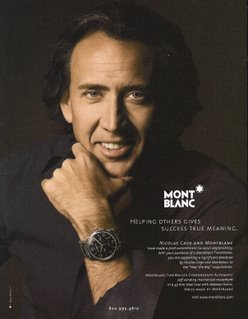
Not enough transparency is what’s wrong with this ad from Montblanc that runs in the Nov. 13 issue of Fortune. The ad features actor Nicolas Cage flashing his best open-mouth celebrity smile with a Montblanc Timewalker chronograph on his wrist. The ad copy tells us that “With your purchase of a Montblanc Timewalker, you are supporting a significant donation by Nicolas Cage and Montblanc to the ‘Heal the Boy’ organization.”
Trouble is, I couldn’t find any mention of Heal the Boy anywhere. That’s not to say it doesn’t exist. It could certainly be a new nonprofit that hasn’t shown up on the radar anywhere. The IRS approves dozens every day. It could be a program of an existing nonprofit. It could be an international nonprofit. The Brits, Canadians and Australians all have ‘registered’ charities that are pretty easy to track online. No doubt other countries do as well, but it’s a little tricky for me (as an English-only speaker) to track charities outside the English-speaking countries.
Heal the Boy may not even be a nonprofit. No law in the U.S. forbids for-profit companies from having non-profit-like 'missions.' Although, needless to say, if Heal the Boy is a for-profit, donations wouldn’t be tax deductible in the U.S.
Nor could I find any mention of Heal the Boy on the Montblanc website or the Nicolas Cage fansites. Montblanc requires that journalists register with them first before they can gain access to press materials. But more than 48 hours has passed since I registered without any word from Montblanc.
I’m prepared to praise the straightforward creative of the ad. I’m anxious to issue kudos to Montblanc, a luxury brand that features cause-related marketing as a key component of their marketing strategy. But I can’t. I can’t because The Wicker Man’s cause needs to be more transparent.
Comments
Amnesty International Will Administer Funds for On-the-ground Efforts to Rehabilitate Young Combatants
(New York) -- Amnesty International USA announced today that actor and filmmaker Nicolas Cage is donating $2 million to establish a fund to help former child soldiers, which will include support for rehabilitation shelters, medical services and psychological and reintegration services, and to support Amnesty International's work on child soldiers.
A non-profit environmental group based in Snata Monica, Calif. that works to protect ocean water quality.